
This catacomb has lain untouched for centuries, the stone covering its entrance not having been moved since the last body was entombed here. The air is stale, old, stagnant, and thick with dust and decay. The silence is heavy and overwhelming, save for the stones and bones rattling and crunching beneath my boots. The pressure of being so far underground weighs on my chest and the darkness is nearly impenetrable. I carry a torch; the fire casting shadows against the walls and tombs. Skeletons wrapped in disintegrating adornments, surrounded by sentimental treasures. Not even the rats seem to be here anymore; any remaining corpse long past the time when they ever had any flesh on their bones. Unexpectedly, the moths come to my light. Awakening from their centuries-old slumber, to flit and dance around the warm flame, bumping into my hand, their soft wings brushing me in ancient dust. Have they been sleeping here among the dead all this time? Had they ever even seen a light before? If they had-would they even remember it? These moths must be in awe of me as the light-bringer, much how I am in awe that they are alive here, in this forgotten place, where there has only been darkness and silence.
Tag: ael library and archives
Ode to a New Journal [7.02.09]
Like a lover, passionate and familiar;
I will fill you.
Like I have so many others before you.
You give me butterflies.
I think about you
when I’m not holding you open
between my hands.
I miss you
when I’m not caught between
these soft pages
And the rough tip of my pencil.
Are all of you my asylums?
Forming crazy words and ramblings
On tens of thousands of blank pages.
I think I’m held captive in these lines.
My entire life scrawled and thrown down
In graphite and ink blots
For people to decipher.
Haikus about being overwhelmed (9-15-20)
I am overwhelmed.
Being pulled all directions.
I am exhausted.
I’m going to hide under my bed.
Don’t get enough sleep.
Schoolwork has taken over.
Too much stuff to do.
My attention being spread too thin.
Clutter baring down.
There’s too much junk in my house.
My life needs cleaning.
I have too many things in on my plate.
Sacrifice [3-14-12]
The eternal love
The last meal
Going into Death’s delicate hands
of love and destruction.
I lay my naked body before you,stretched over the bed
as though it were an alter.
Your blade can swim through my skin
as sharks slice through water.
My flesh will gift you with rubies.
My bare throat catching moans
like small birds in flight.
Witch’s Kit Bag (10-9-18)
Her gnarled and wrinkled hands, long fingers like spider’s legs, nails like daggers, clutched the black leather bag and its two handles. It had served her well for centuries; larger on the inside than it appeared on the outside, and only ever weighing hardly anything. It sat aerodynamically upon the tail of her broom and always match her dress. She set the bag down and unclasped its buckle, rummaging through its contents for the supplies she needed for her spell work. It contained innumerable items, both ancient and modern, used for purposes both good and sinister.
Reference books and spell books and her book of shadows. Crystals and metals and minerals and gems. A portable iron cauldron, a broom repair kit, and charged water from a Solstice. Various bundles and satchels and jars of both fresh and dried, medicinal and poisonous, herbs and plants. Salt and honey and the powdered wood of various trees. Holy symbols and statues and effigies of Gods and Goddesses. Candles of beeswax in every color conceivable. A corn dolly, a voodoo doll, and figures formed of clay. Bottles of ink, and feather quills, and parchment for notes. Ancient rune stones, tea leaves, tarot cards, and a crystal ball. A curved boline, an athame, an axe, and a wand. Burlap sacks, a wicker basket, pruning shears, a mortar and pestle, Alchemist’s refining tools, and grain alcohol.
These items and so much more. Each one having numerous uses, each one gathered and well-used in her travels. Some fear her, some love her, but most know her work by name. So many years. So many people. So many spells and remedies and ceremonies. Her old hands find each item where it should be, and she lays them out, preparing her workspace, and centering her mind. A witch’s work is never done it seems.
Ghost Hitchhiker (2-15-20)
It was late at night, far into the winter, and deeply cold outside.
The snow fell steadily, blanketing all and sticking.
Then, the snow stopped and the temperature rose.
Just enough to make-wet the streets
And make fog rise from the ground.
I was driving my pickup truck; headlights on.
The fog was so dense I couldn’t see 15 feet in front of my own bumper.
I drove slowly down country roads,
Watching for ice and monsters alike.
I hit the outskirts of town, traffic driving by me from the opposite direction.
I turned a corner to see a semi a ways away,
Its headlights illuminating a man crossing the street,
And pausing to stand in the middle of the road.
The distance between the semi and I closed,
And as the glowing beams of our headlights touched,
There was no longer a man standing there.
He was gone, completely.
Disappeared into the fog or the night,
Making me suddenly truly believe all my Grandfather’s stories
About ghostly hitchhikers on the road at night.
Guest Blog Essay on the Natural and Cultural History of Rabbits [2015]
The original blog article posted with accompanying photos: http://ohiothoughtsblog.blogspot.com/2015/02/rabbits-natural-and-cultural-history.html
Rabbits are remarkable and fascinating creatures that deserve appreciation, so I think a bit of an overview is in order:
Rabbits (Sylvilagus) and Hares (Lepus) of North America belong to the Order and Family Lagomorpha Leporidae, and in total there are 29 species of rabbits and 32 species of hares.
So what’s the difference between a rabbit and a hare?
Rabbits are altricial; meaning they are born in an undeveloped state and require care and feeding by the parents. Rabbits are born naked and blind into fur-lined nests in burrows below ground. They stay in the nest tended to by their mother for a couple of weeks.
Hares are precocial; meaning they are born in an advanced state and able to feed themselves almost immediately. Hares are born above ground, furry and open-eyed, and cared for in the open. Less than five minutes after birth they are able to hop and can leave the nest almost immediately. Hares on average grow larger than rabbits and have longer legs, feet, and ears.
When danger is afoot, rabbits will hide whereas hares will flee. Rabbits are more social and tend to live in groups, whereas hares enjoy their solitude with the exception of mating. All rabbits and hares, or Lagomorphs, can see nearly 360 degrees, with their blind spot at the bridge of the nose, and they can sleep with their eyes open.
Lagomorphs are believed to have existed at least 53 million years ago; the modern rabbit families developing around 35 million years ago, although little is known about rabbits in prehistoric times. Lagomorphs are located on every continent except Antarctica, and are a vital part of nature’s food chain; being eaten by a vast majority of predators across the globe; mammal, avian, and reptilian alike.
Rabbits have been involved with humans from an early stage; initially and primarily as a food source, and then developing as a part of our artistic and theological culture. Archaeologists have evidence of people hunting rabbits in the South of France 120,000 years ago, and a famous cave painting of rabbits in Le Gabillou, France dates to 25,000 B.C.E. A recent study has shown that during the last ice age (40,000-10,000 years ago), early modern humans and the last of the Neanderthals may have survived on diets made up largely of rabbit.
The Saxons/ Germanic: Festivals celebrating the Goddess Eostre/Oestre, took place at the Spring Equinox. She is often depicted with a hare’s head or ears and with her favorite white hare standing by her side. This hare laid colored eggs. All hares were sacred to her, and were her messengers. It is also believed she could change into a hare on a full moon. Eostre represented birth, renewal, love, fertility, the sunrise, redemption, and renewal of life. Her followers would make offerings of milk and honey, as well as colored eggs, which were given to children. These ancient pagan tradition survived and are continued today in the modern secular form as the Easter bunny.
The Celts: Rabbits and hares were used for divination and other shamanic practices by studying the patterns of their tracks, the rituals of their mating dances, and mystic signs within their entrails. It was believed that rabbits burrowed underground in order to better commune with the spirit world, and that they could carry messages from the living to the dead and from humankind to the faeries. It was generally believed that female rabbits could conceive and give birth without contact with the male of the species, and thus virginal white rabbits appear in biblical pictures. “The Madonna with the rabbit”; a painting done by Titian in 1530 shows the Virgin Mary holding a pure white rabbit.
Boudicca the Celtic warrior queen was said to have released a hare as a good omen before each battle and to divine the outcome of battle by the hare’s movements. She took a hare into battle with her to ensure victory and it was said to have screamed like a woman from beneath her cloak.
Americas Mythology: In Aztec Mythology the Centzon Totochtin (“Four-hundred Rabbits”) was a group of deities who acted collectively as the “Dionysus of Mexico”, the divine little gods of drink and drunkenness. In the folklore of some Southeastern American Indian tribes (like the Cherokee), it was the trickster Rabbit Jistu, who stole fire and brought it to the people.
Asia; Jade Rabbit, maker of medicine for the Chinese gods, lives on the moon and is often depicted with a mortar and pestle.
Egyptians: Coincidentally; in Egyptian myth, hares were closely associated with the cycles of the moon, which was viewed as masculine when waxing and feminine when waning. A hare-headed god and goddess can be seen on the Egyptian temple walls of Dendera, where the female is the goddess Unut and the male is representation of Osiris, who was sacrificed to the Nile annually in the form of a hare. In ancient Egypt the hare was used as a Hieroglyph for the word denoting existence.
Greeks: Hares were also associated with Artemis the Greek goddess of wild places and the hunt, and newborn hares were not to be killed but left to her protection. Rabbits were sacred to Aphrodite, the goddess of love, beauty, and marriage—for rabbits had “the gift of Aphrodite” (fertility) in great abundance. The gift of a rabbit was a common love token from a man to his male or female lover. In Rome, the gift of a rabbit was intended to help a barren wife conceive. Carvings of rabbits eating grapes and figs appear on both Greek and Roman tombs, where they symbolize the transformative cycle of life, death, and rebirth. Hares were likewise believed to be androgynous, shifting back and forth between the genders up until the 18th century.
Romans: More than 2,000 years ago, the Romans systematically exported European rabbits too many countries, through a vast trade network; the Silk Road. They were the first to set up large operations for the production of breeding and raising of rabbits, done in large stretches of enclosed acres, called “warrens”-what I like to call a “free-for-all”.
The Romans caught, sold, traded and ate them, but they were not responsible for the deliberate domestication of rabbits.
Irish: A symbol known as The Three Hares, or “The Tinner’s Rabbits” in Ireland, shows three hares chasing each other in an unbroken circle. Each of the ears is shared by two hares, so that only three ears are shown. Like the triskelion, the symbol of the three hares has a threefold rotational symmetry. Although its meaning is unknown, it is thought to have symbolic or mystical associations. It appears in diverse locations across Europe and some believe its meaning is tied to fertility, rebirth and the lunar cycle. When used in Christian churches, it is presumed to be a symbol of the Trinity. The earliest occurrences of this symbol appear to be in Buddhist cave temples in China, dated to the 6th / 7th centuries. The Three Hares also appears on 13th century Mongol metalwork, as well as a copper coin found in Iran, dated to 1281.
Catholic Monks: The domestication of rabbits is credited to medieval French monks, dating to the beginning of the 6th century, 500-1000 CE. Living in the Champagne region of France developed the earliest standard domestic breed; a Silver aptly called the “Champagne D’Argent” in 1500. (A breed I am currently raising) Then rabbit meat gained even more popularity; the Catholic Empire deemed rabbit fit for consumption during Lent, in the same way fish was. Comparatively; Caesar recorded that rabbits were taboo foods to the Celtic tribes.
Rabbits as Pets: It is thought that around the Middle ages is when noblewomen first started keeping rabbits as pets, but it was not until the Victorian era that rabbits as pets really took hold. And by the 1800’s, the domestic keeping and breeding of rabbits for meat and furs was done by all social levels of people and was no longer solely dominated by the rich or the royals. In more modern times, Neapolitan, Beatrix Potter and even Clint Eastwood had pet rabbits.
I had written a blog article before this one about why I had decided to start raising meat rabbits on our farm. This was going to be a continuing series, with the next write up being about butchering the rabbits and preparing their meat. I did not end up writing anymore in this series.
The original blog article posted with accompanying photos: http://ohiothoughtsblog.blogspot.com/2015/02/rabbits-natural-and-cultural-history.html
In the Barn During a Thunderstorm [8.16.09]
The sky flickers like an off-channel TV screen, the black and white fuzzy flashing. Sunflower cover the horizon, their shadows playing with me in the dark, casting lies against the side of the barn. I swear I can see the outline of a man, hunkered below their heavy drooping heads. A gust of wind makes them bend and shake, playing tricks on my eyes again and again. Am I still alone here in this barn? I become nervous, pulling my Winchester pocket knife out, opening it up, and squeezing it in my left hand while I write. It was all so strange, sitting on the lowest bales of hay, watching the heat lightening on the East side of the barn. The chickens are much bigger now than the stout fuzzy bodies they had a month ago. They softly fluff their feathers and cluck under their breath, the straw beneath them rustling as they stir their feet. The rain on the barn roof came down in a light mist, until finally, the skies opened up and large dense drops fell and splashed to the wheat fields and barn below. The wind blew in through the broken windows and whistled through my ears, tossing about my paper and all the tufts of hay that stuck out awkwardly and messy from their bales; frail bodies shaking.
Grief [8-1-18]
Today I drew the cards
And they told me that to flourish
in my writing, and in my life,
I need to allow myself to feel my grief.
Because it withholds me,
Cripples me,
Retrains me.
That I must stop concealing my pain.
Stop hiding my broken emotions.
Stop hiding my sadness.
My loss is my power.
My devastation is my fuel.
My anguish is my battery.
My trauma is my fire.
To use in my writing, and to write about.
But it hurts.
It takes so much out of me
To put so much of a broken life on paper.
I blanket and hide and conceal and distract
So my heart isn’t heavy.
So I can sleep at night.
So I can find happiness in the things that used to make me happy.
I have been told that I am a pit of misery,
So I stopped, and became something else.
But apparently I need to shed my skin,
And allow myself to feel,
To heal and move on.
Poetry Magnets [2016]
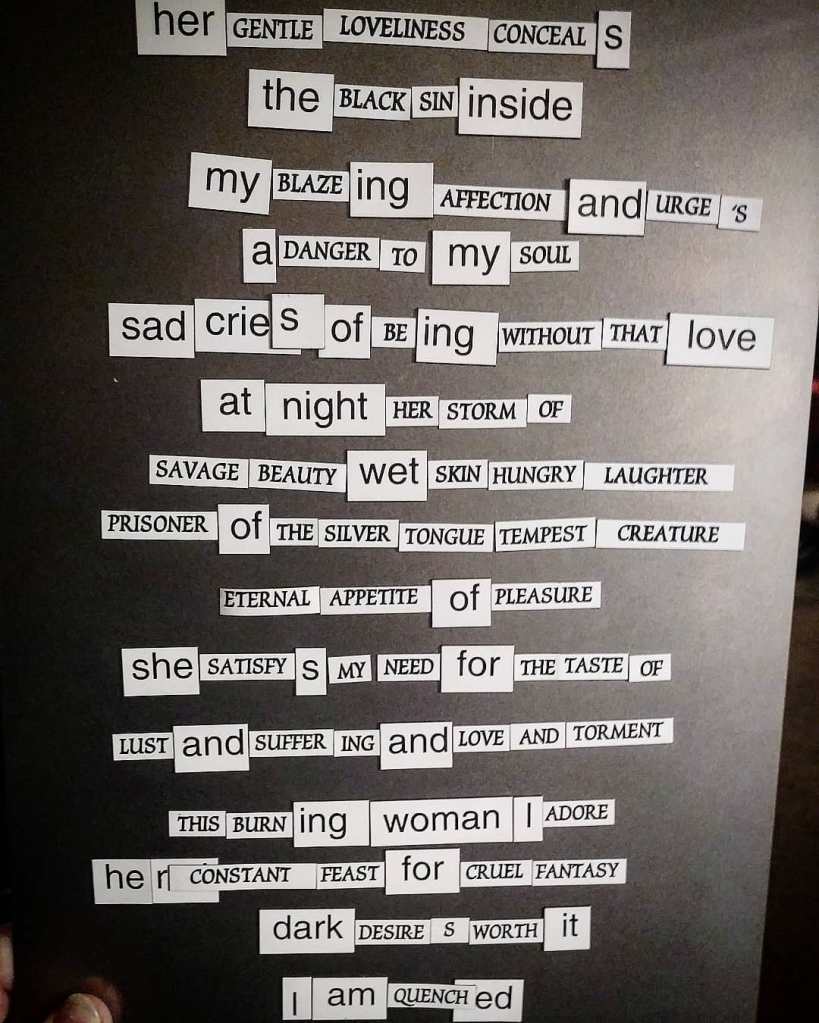
 AEL Library & Archives